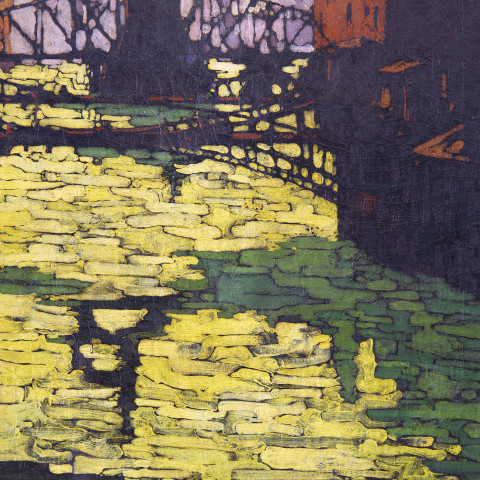
William Thomas (Will) Hollingsworth, was an American painter, illustrator, and educator whose career spanned early twentieth-century modernism, commercial illustration, and postwar abstraction. Born on May 10, 1891, in Louisville, Kentucky, Hollingsworth completed only a grammar-school education before entering the workforce at a young age. Following the disappearance of his father and financial hardship within the family, he worked in the accounting office of the Louisville & Nashville Railroad while nurturing an early interest in art.
In 1912, Hollingsworth moved to Chicago, where he enrolled at the Academy of Fine Arts. Supporting himself through a variety of jobs, he distinguished himself sufficiently to remain at the Academy as an instructor after completing his studies. During this period, he was actively exhibiting and developing a body of work that included portraiture, urban views, and industrial subjects. His Chicago years are documented through exhibition records dating from 1918 to 1922, during which he resided at addresses on Cedar Street and East Erie Street.
Among the notable works from this period are Bridge in the Rain (1920, watercolor) and Three Bridges (1921, oil on canvas), the latter reflecting a strong structural sensibility and engagement with the industrial landscape of Chicago. Other works from the early 1920s—such as Green Fog, Red Steel, and Path of the Tug—demonstrate a modernist approach to atmosphere, form, and urban energy, while portraits such as My Mother, Constance, and Jean reveal a continued commitment to figurative painting.
In 1920, following a commission to oversee decorative work for a new Shubert Theatre in Chicago, Hollingsworth fulfilled a long-held ambition to study abroad. He relocated to Paris, where he lived and worked for approximately five years. During this time, he painted extensively and achieved modest commercial success, selling paintings and contributing woodcut illustrations to American magazines.
While in Paris, Hollingsworth met Edith “Buckie” Buckner Kirk, an art editor associated with Century Magazine, which had previously published his work. The two married in 1925 and returned to the United States, settling on the East Coast. Hollingsworth established himself as a successful commercial artist and illustrator in New York, producing watercolor and gouache paintings for major advertising clients, including Canadian Pacific Railways, Pitcairn Autogiros, and Forstmann Woolens. His work for Forstmann—fashion illustrations depicting women in the company’s textiles—became his most significant commercial engagement and continued into the mid-1930s.
As photography increasingly replaced painted illustration in advertising, Hollingsworth’s commercial career declined. In the late 1930s and early 1940s, he shifted his focus toward portraiture and independent studio work while living in Rockland County, New York. During this period, he worked primarily in oil, painting neighbors and acquaintances, and exhibited intermittently. Works such as Black and White (1935) and later watercolors including Siesta and Home on Furlough (1944) reflect a restrained palette and increasing formal abstraction.
In 1947, Hollingsworth was appointed Curator of the Saint-Gaudens Memorial in Cornish, New Hampshire, with his wife serving as Secretary. This role marked a renewed period of artistic productivity. While overseeing the museum during the summer months, he returned decisively to painting, initially exploring surrealist imagery before moving toward semi-abstract and abstract compositions, often inspired by the New England landscape. His work from this period was exhibited widely, including solo exhibitions in New York, and entered institutional collections such as the Hopkins Center for the Arts at Dartmouth College.
After retiring from the Saint-Gaudens Memorial in 1957, Hollingsworth and his wife settled in Windsor, Vermont. There, he established a studio, taught art classes, and continued painting well into his later years, producing increasingly abstract works. William Hollingsworth died on November 10, 1975, in Windsor, Vermont.
Exhibition History
Art Institute of Chicago
Annual Exhibitions of Artists of Chicago and Vicinity
1918
Address: 21 Cedar Street, Chicago
Tennis
1918 (C)
Address: 21 Cedar Street, Chicago
My Mother
1920 (W)
Address: 153 East Erie Street, Chicago
Bridge in the Rain (watercolor)
1921 (C)
Address: 153 East Erie Street, Chicago
Constance
Green Fog
Red Steel
Three Bridges (oil on canvas)
Path of the Tug
1922 (C)
Address: 153 East Erie Street, Chicago
Jean
1935
Address: Not listed
Black and White
1937 (W)
Address: Not listed
Black and White (watercolor)
Siesta (watercolor)
1944 (W)
Address: Not listed
Home on Furlough (watercolor)
New York and East Coast Exhibitions
1920s–1930s
New York City
Hollingsworth exhibited paintings and works on paper in New York during the interwar period while working as a commercial illustrator. Although specific exhibition titles and venues are not fully documented, his professional standing is evidenced by:
Regular publication and illustration work for national magazines
Commercial painting commissions for Canadian Pacific Railways, Pitcairn Autogiros, and Forstmann Woolens
Active participation in the New York art community during the transition from hand-painted illustration to photographic advertising
Solo Exhibitions
1950s–1960s
Nicholas Roerich Museum, New York
One-person exhibition (paintings)
This exhibition marked a significant moment in Hollingsworth’s postwar career and reflected his mature artistic direction, including surrealist and semi-abstract works.
Additional solo exhibitions during this period are documented, though venues are not fully recorded.
Institutional Exhibitions and Collections
Hopkins Center for the Arts, Dartmouth College
Hanover, New Hampshire
Two paintings by Hollingsworth acquired for the permanent collection
Works likely exhibited in connection with institutional programming during the mid-20th century
Museum Appointments and Related Exhibition Activity
Saint-Gaudens Memorial (now Saint-Gaudens National Historical Park)
Cornish, New Hampshire
1947–1957
Curator: William Hollingsworth
Secretary: Edith “Buckie” Hollingsworth
While serving as Curator, Hollingsworth was actively painting and exhibiting. His association with the Memorial placed him in direct professional contact with museum audiences, scholars, and artists, and coincided with a period of renewed productivity and stylistic experimentation. Works from this era include surrealist compositions and later semi-abstract landscapes.
Regional Exhibitions and Teaching-Related Activity
Late 1950s–1970s
Vermont and New Hampshire
Exhibited locally and regionally while living in Windsor, Vermont
Maintained a private studio and taught art classes
Continued producing abstract and semi-abstract paintings until his death in 1975