Jean Lambert-Rucki was a Polish-French avant-garde artist born in Krakow, Austria-Hungary (Poland), in 1888. He studied at the Fine Arts Academy of Krakow before moving to Paris in 1911, where he trained at the Colarossi Academy and worked as a retoucher in a photography studio. After serving in World War I, he settled in the Montparnasse district, befriending fellow Krakow-born artist Moise Kisling, as well as Modigliani, Soutine, and other Montparnasse artists. Following service in the First World War in the Foreign Legion, he worked as an archaeologist at the Archaeological Museum in Thessaloniki, Greece.
His successful exhibition career began at the Salon d'Automne in 1919 with regular exhibits at the Salon des Indépendants beginning in 1920. Notably, he showed with the Cubists in the Section d'Or group from 1922 to 1924, and in 1924, he was represented by Léonce Rosenberg's gallery, the Galerie l'Effort Moderne, and the art dealer Paul Guillaume. Lambert-Rucki participated in the historic exhibition of the Union des Artistes Modernes (UAM) in 1930, formed by a group of Modernists disillusioned with the traditional Societé des Artistes Décorateurs (SAD). He continued to show his works with the UAM in subsequent years, exhibiting alongside figures like René Herbst, Charles-Édouard Jeanneret (Le Corbusier), and Robert Mallet-Stevens. His work continued to gain recognition in major Parisian shows with exhibitions at the Salon d’Automne and the Salon des Tuileries beginning in 1933, followed by his inclusion in the Pavillon de l’Union des Artistes Modernes at the 1937 Exposition Universelle in Paris.
In addition to paintings, sculptures, and graphic art, Lambert-Rucki designed jewelry produced by master jeweler Jean Fouquet and shown in the Pavillon de la Lumiére, as well as furniture for Dunand, which found success at the height of the Art Deco movement.
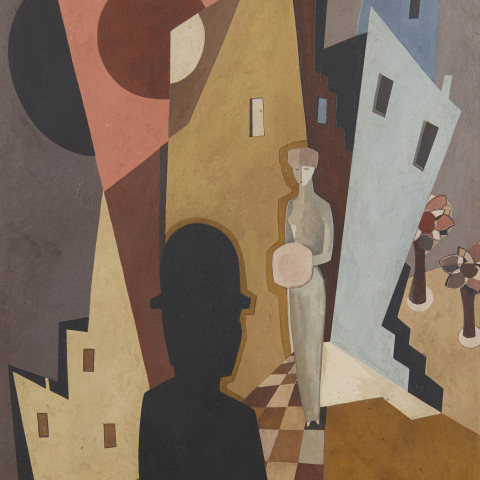
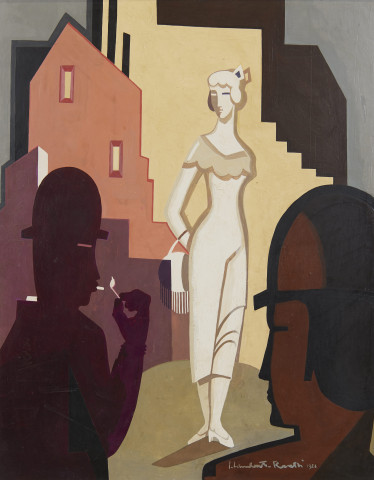
Across his diverse range of media, Lambert-Rucki created fine works in the Cubist, Surrealist, and Art Deco styles. La Dame au Manchon (1920) and Le Passage (1926) are notable examples of his Cubist-Surrealist style, with simplified figures and shadowy forms in compressed architectural scenes. This style recalls the works of his friend, Russian-Danish painter Léopold Survage, as well as René Magritte's silhouetted man in a bowler hat.
His work is in private and public collections, including the Center Georges Pompidou in Paris, the Musée d'Évreux in Normandy, the Musée départemental de l'Oise in Northern France, and the Mount Angel Abbey Museum in the United States, among others.
Sources:
AskArt via Papillon Gallery and Polswissart Gallery
https://www.comitejeanlambertrucki.com/biography/
https://www.oxfordreference.com/display/10.1093/oi/authority.20110803110717894