Born 10 February 1887, Biesingen (Baden-Württemberg), Germany
Died 17 September 1968, Montebello, California, USA
Carl Frederick Binder was born in 1887 in Biesingen, in the Black Forest region of southern Germany. He received rigorous academic training in Europe, studying first at the Kunstgewerbeschule (often referenced in period sources as the Knackfuss School) in Kassel and later at the Kunstakademie Düsseldorf. There he developed a disciplined approach to draftsmanship, composition, and tonal structure that would remain foundational throughout his career.
Binder emigrated to the United States in 1910 and settled in Cleveland, Ohio, where he became an American citizen during the First World War era. By the early 1920s he was living in Cleveland Heights and working professionally as a color lithographer for both Otis and Morgan Lithography, a position that placed him at the center of Cleveland’s thriving graphic arts industry. His technical mastery of lithography developed in parallel with a sustained practice in oil painting.
During the interwar years, Binder emerged as a respected participant in Cleveland’s modernist milieu. He exhibited regularly in the Cleveland Museum of Art’s prestigious May Show from 1923 through 1935, an exceptional record of sustained institutional recognition. Between 1924 and 1928, his work received prizes at the Cleveland Museum of Art, and several of his lithographs entered the museum’s permanent collection, many through the Print Club of Cleveland.
In 1929, Binder was elected to active membership in the Kokoon Club, Cleveland’s influential artist-run organization dedicated to modern art and experimentation. His membership placed him in direct dialogue with leading figures such as William Sommer, Henry G. Keller, Clarence H. Carter, and other artists associated with the city’s modernist circle. While Sommer’s influence is evident in Binder’s simplification of form and expressive spatial organization, Binder retained a greater degree of representational clarity and narrative structure, resulting in a restrained but distinctly modern realism.
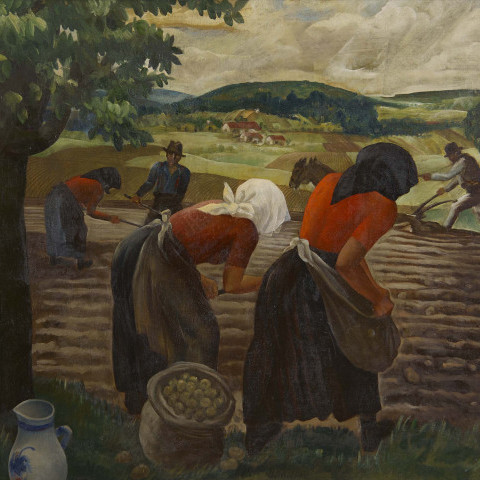
Binder’s paintings often focused on rural labor, agrarian life, and figurative scenes drawn from both European memory and American experience. Between 1923 and 1935 he was a consistent and prize‑winning participant in the Cleveland Museum of Art’s annual May Show, exhibiting more than fifty works across painting, watercolor, lithography, and drawing. These entries—ranging from major compositions such as The Young Harvesters, The Toilers, and In the Schwabian Alps to intimate still lifes and figure studies—demonstrate both the breadth of his practice and his sustained institutional recognition during the interwar period. His 1931 painting The Toilers stands among his most significant works. Depicting agricultural workers bent rhythmically across a cultivated field, the composition is notable for its monumentalized figures, controlled palette, and strong underlying structure. The work reflects broader interwar American interests in labor and social subject matter while retaining a compositional discipline rooted in European training.
Binder’s reputation extended well beyond Cleveland. In 1932, he was selected for the Thirteenth Biennial Exhibition of Contemporary American Oil Paintings at the Corcoran Gallery of Art in Washington, D.C., one of the most important national exhibitions of the period. Contemporary reviews placed him among a distinguished roster of American artists that included Edward Hopper, John Sloan, George Luks, Rockwell Kent, Charles Sheeler, and Charles Burchfield.
In 1937, Binder was again included in a major national survey, Paintings and Prints by Cleveland Artists, at the Whitney Museum of American Art in New York. Organized as part of the Whitney’s influential regional exhibition program, the exhibition identified Cleveland as a center of exceptional vitality in American art and positioned Binder among the city’s leading figures.
In addition to his painting practice, Binder was an accomplished lithographer whose prints frequently addressed figurative, pastoral, and allegorical themes. His lithographs were praised for their structural clarity, tonal balance, and expressive restraint. Several entered the permanent collection of the Cleveland Museum of Art, and his work circulated widely through print clubs and exhibitions.
Binder’s painting The Lunch Basket (1927) was acquired by the Pennsylvania Academy of the Fine Arts, further confirming his national institutional presence. Although his reputation diminished in the postwar period, Binder’s career exemplifies the role of European-trained artists in shaping American modernism at both regional and national levels. His work remains preserved in museum collections and archives, particularly in Cleveland, where his legacy is most firmly rooted.
Carl F. Binder died in 1968 in Harbor City, California.
Education
Kunstgewerbeschule (Knackfuss School), Kassel, Germany
Kunstakademie Düsseldorf, Germany
Selected Solo Exhibitions
Kokoon Club, Cleveland, OH (one-man exhibition, c. 1931)
Selected Group Exhibitions
Cleveland Museum of Art, May Show (Annual Exhibition of Cleveland Artists and Craftsmen), Cleveland, OH (1923–1935)
Art Institute Chicago, American Paintings and Sculpture, Forty-Second Annual Exhibition, Chicago, IL, 1929
Carnegie Institute, Twenty-Eigth International Exhibition of Paintings, Pittsburgh, PA, 1929
Corcoran Gallery of Art, Thirteenth Biennial Exhibition of Contemporary American Oil Paintings, Washington, D.C., 1932
Whitney Museum of American Art, Paintings and Prints by Cleveland Artists, New York, NY, 1937
Print Club of Cleveland, group exhibitions, Cleveland, OH
Pennsylvania Academy of the Fine Arts, Annual Exhibition, Philadelphia, PA (work acquired, 1928)
Cleveland Museum of Art — May Show Entries
1923 (Fifth Annual Exhibition)
-Peasant Mothers (oil painting)
1924 (Sixth Annual Exhibition)
-The Young Harvesters (oil painting)
-Still Life (oil painting — Third Prize)
-The Beauty of Nature (oil painting — Third Prize)
-Still Life (decorative oil painting)
-Girl with Flowers (oil painting)
1925 (Seventh Annual Exhibition)
-Still Life (oil painting)
-Moon and Sunshine (oil painting)
-House in the Hills (oil painting)
1926 (Eighth Annual Exhibition)
-Sunny September (oil painting)
-Among Trees & Flowers (oil painting)
-Iris & Fritillaria (oil painting)
-Resting After the Bath (oil painting)
-Decoration (watercolor)
1927 (Ninth Annual Exhibition)
-Still Life (oil painting)
-Decoration in Tempera or Crayon
-Ideal Day (lithograph — First Prize)
-Earl (lithograph)
1928 (Tenth Annual Exhibition)
-In the Schwabian Alps (oil painting)
-The Garden of Eden (lithograph)
-Returning from the Field (lithograph)
-The Jewish Basket (lithograph)
-Resting Time (lithograph)
1929 (Eleventh Annual Exhibition)
-Give Us This Day Our Daily Bread (oil painting)
-Still Life with Lamp (oil painting)
-Baby Earl (lithograph)
-Anthony Young (lithograph)
-The Garage (lithograph)
-The Alpine Shepherd (drawing)
-The Canal (drawing)
-One Day on the Farm (drawing)
-The Mountain Stream (drawing)
-Drumles of the Night (drawing)
-The Valley of the Blue Danube (drawing)
-Three Youthful Bathers (drawing)
1930 (Twelfth Annual Exhibition)
-Schwabian Mother (oil painting)
-Flowers in Your Garden (oil painting)
-Nudes (oil painting)
-The Toilers (oil painting)
-A Spring Day (oil painting)
1931 (Thirteenth Annual Exhibition)
-The Toilers (oil painting)
-Song and Dance (oil painting)
-A Lady in Red (oil painting)
-Babies (oil painting)
-Aechmea Fasciata (watercolor)
-The Katz Kill Mountains No. 1 & 2 (oil paintings)
-The Spirit of Oberammergau (oil painting)
-A Castle on the Rhine (oil painting)
-Along the Blue Danube (oil painting)
-A Clear Day in the Mountains (oil painting)
-Flowers and Cat (drawing)
-The Broken Tulip (drawing)
1932 (Fourteenth Annual Exhibition)
-An Ideal Day (oil painting)
-The Old Stone Quarry (oil painting)
-Cactus Flowers (oil painting)
-Yellowstone River Falls (oil painting)
-Yellowstone River (oil painting)
-The Mountain Pass (oil painting)
-Susan at the Bath (oil painting)
-Flowers at the Window (watercolor)
-The Swimming Hole (watercolor)
-Stained Glass Window (design; glazing by Biver Art Glass Co.)
1933 (Fifteenth Annual Exhibition)
-Two Maidens (oil painting)
-Family Outing (oil painting)
-Early Spring (watercolor)
-Mountain Farm (watercolor)
-The Farm Barn (watercolor)
-European Silo (watercolor)
-The Quarry (watercolor)
1934 (Sixteenth Annual Exhibition)
-Figure Composition (oil painting)
-Still Life (oil painting)
-The Farm (oil painting)
-Decorative Painting (oil painting)
-Flowers (watercolor)
-Flowers at the Window (watercolor)
-The Earth Laughs (watercolor)
-Give Us This Day Our Daily Bread (watercolor)
1935 (Seventeenth Annual Exhibition)
-The Model (oil painting)
-Flowers (oil painting)
-Fruit & Flowers (oil painting)
-Along the Railroad (watercolor)
-Farm Buildings (watercolor)
-Still Life (watercolor)
-Flowers (watercolor)
-Head of Jesus (freehand drawing)
-The Old Mill (freehand drawing)
Awards and Honors
Multiple prizes, Cleveland Museum of Art, May Show exhibitions (1924–1928)
Museum Collections
Cleveland Museum of Art, Cleveland, OH (paintings and lithographs)
Pennsylvania Academy of the Fine Arts, Philadelphia, PA
Professional Affiliations
Kokoon Club, Cleveland (Active Member, elected 1929)
Print Club of Cleveland
Media and Publications
The Bystander (Cleveland), reviews and reproductions of Binder’s work, late 1920s–early 1930s
Cleveland Museum of Art Bulletins and exhibition catalogues
Art Institute Chicago, American Paintings and Sculpture, Forty-Second Annual Exhibition Catalog